How Much Does a Metal Roof Cost in Lancaster County, PA?
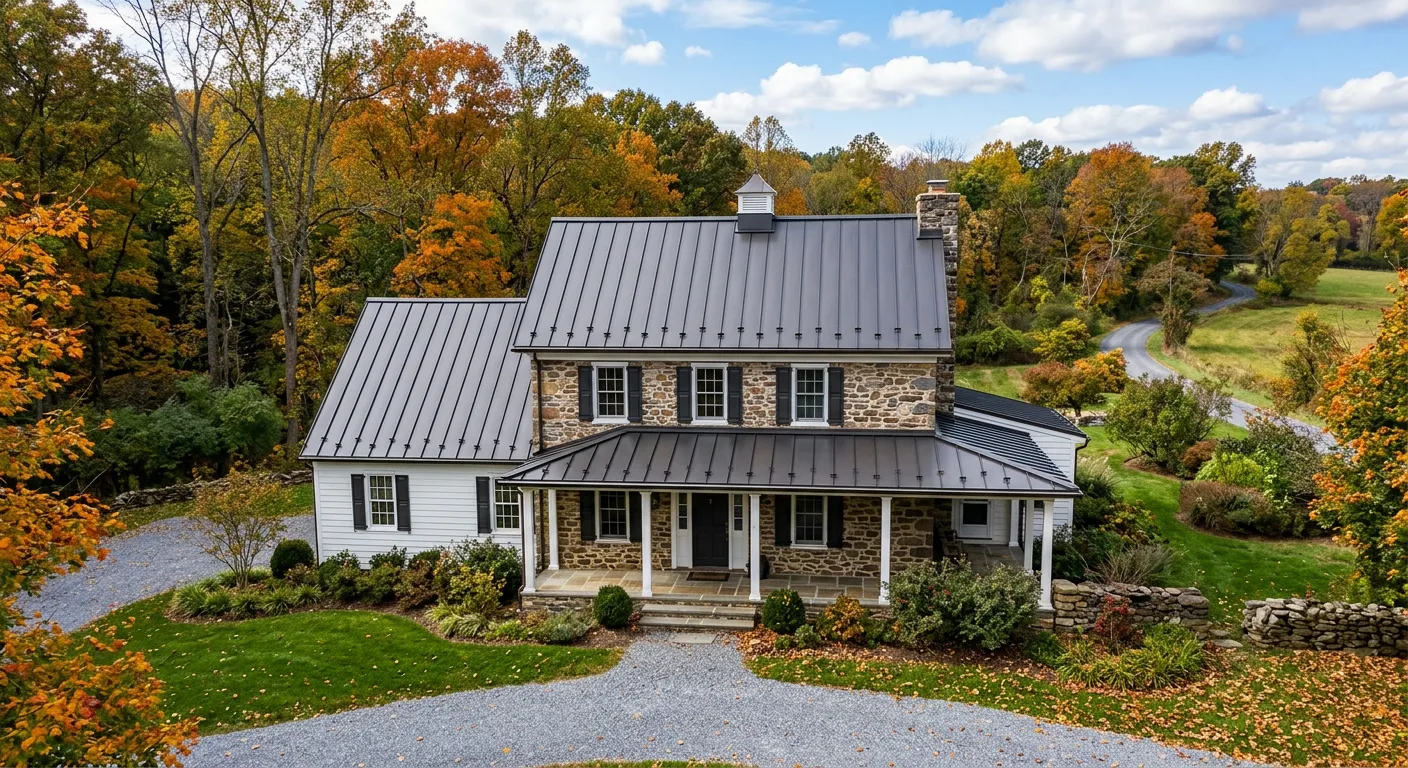
Most Lancaster County homeowners can expect a new metal roof to cost between $5 and $16 per square foot installed for common steel systems in 2026 — roughly $10,000 to $32,000 for a typical 2,000-square-foot roof. Nationally, Angi puts the average metal roof at $11,754, with most projects landing between $6,045 and $18,326 (Angi, 2026).
The spread is wide because "metal roof" covers everything from budget corrugated panels to copper. This guide breaks down 2026 prices by material, the factors that move your quote up or down here in Lancaster County, and whether the long-term math beats asphalt shingles.
Key Takeaways
- Common steel metal roofs run $5–$16 per sq. ft. installed; standing seam averages about $19,000 per project nationally (Angi, 2026; HomeGuide, 2026).
- Labor is roughly 60% of the total, and Lancaster-metro roofing wages sit slightly below the Pennsylvania median — one reason local quotes often land mid-range nationally (Angi; BLS May 2025 data).
- Metal costs more upfront than asphalt but can last 60+ years per Metal Construction Association field research — often the lower cost per year of service.
- Steel and aluminum tariffs doubled to 50% in June 2025, so get written quotes with locked material pricing.
Average Metal Roof Cost in Lancaster County, PA
Plan on $10,000–$32,000 for a typical 2,000 sq. ft. roof in common steel systems, with premium metals well above that. The same Angi 2026 dataset averages $11 per square foot installed, with a full range of $4–$30 depending on material and complexity; HomeGuide's 2026 guide reports similar ranges.
Local labor keeps Lancaster County near the middle of those national ranges. Roofers in the Lancaster metro earn a median of $25.31 per hour ($52,640/year), slightly below Pennsylvania's statewide median of $26.79, per May 2025 federal wage data (BLS OEWS via O*NET). Since labor makes up about 60% of a roofing project's cost (Angi), competitive local wages matter more to your bottom line than material shipping ever will.
| Roof size | Corrugated steel | Standing seam steel |
|---|---|---|
| 1,000 sq. ft. | $5,000 – $12,000 | $9,000 – $16,000 |
| 1,500 sq. ft. | $7,500 – $18,000 | $13,500 – $24,000 |
| 2,000 sq. ft. | $10,000 – $24,000 | $18,000 – $32,000 |
| 2,500 sq. ft. | $12,500 – $30,000 | $22,500 – $40,000 |
| 3,000 sq. ft. | $15,000 – $36,000 | $27,000 – $48,000 |
Estimated installed ranges calculated from national per-square-foot data: corrugated $5–$12, standing seam $9–$16 (HomeGuide, 2026). Your roof's pitch, tear-off, and trim details move the number within — or past — these ranges.
If you'd rather skip the math and see a real number for your home, our metal roofing installation team measures the roof and itemizes the estimate line by line.
Metal Roofing Prices by Material Type
Material choice is the single biggest price lever. Corrugated steel is the entry point; copper costs five to eight times more per square foot. Here's how 2026 installed prices compare.
| Material | Installed cost / sq. ft. | Best for |
|---|---|---|
| Corrugated / exposed-fastener steel | $5 – $12 | Budget projects, barns, outbuildings |
| Stone-coated steel | $7 – $13 | Shingle or tile look with steel durability |
| Standing seam steel | $9 – $16 | Homes; hidden fasteners, longest steel life |
| Zinc | $14 – $20 | Self-healing patina, multi-generation lifespan |
| Steel (full-scope 2026 estimates) | $16 – $23 | Complex residential replacements |
| Aluminum | $17 – $25 | Rust-proof; lightweight panels |
| Copper | $29 – $41 | Historic homes, accents, bay windows |
Two notes on reading that chart honestly. First, the steel figure of $16–$23 comes from This Old House's April 2026 update, which uses Homewyse contractor estimates for full-scope replacements — it runs higher than Angi and HomeGuide because it bakes in post-tariff 2026 pricing and complete tear-off scope. Second, standing seam projects average about $19,000 nationally, with a $9,400–$32,600 range (Angi, 2026).
For most Lancaster County homes, the practical decision is corrugated versus standing seam. Corrugated saves money upfront but leaves fasteners exposed to weather. Standing seam hides every fastener under a raised seam, which is why it dominates on houses while corrugated stays popular on barns and outbuildings.
What Drives Metal Roof Cost Up or Down
Two identical-sized roofs can quote thousands of dollars apart. These are the factors doing the moving.
Roof complexity and pitch
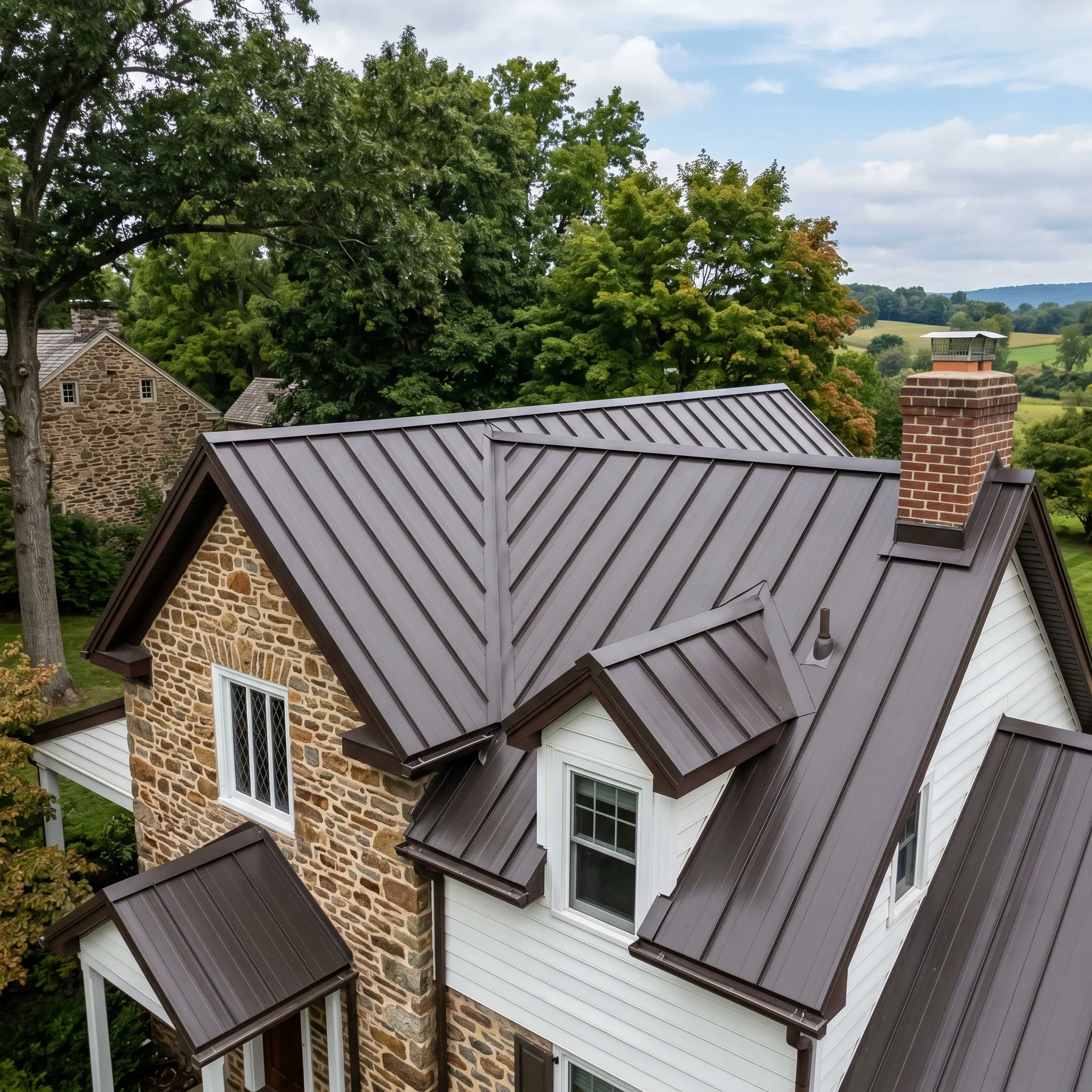
Valleys, dormers, chimneys, and skylights all require flashing work and panel cuts. A steep pitch slows the crew down and adds safety equipment. Simple gable roofs sit at the bottom of the ranges above; cut-up rooflines climb toward the top.
Labor
At roughly 60% of project cost (Angi, 2026), labor is the biggest line item. Standing seam demands more skill than corrugated — panels are often site-formed and hand-seamed — which is part of its premium.
Tear-off vs. overlay
Removing and disposing of old shingles adds cost but lets the installer inspect and repair decking. An overlay saves money where code and decking condition allow it. You can see how finished projects turned out either way in our metal roofing project gallery.
Steel and aluminum tariffs
Material prices moved in 2025: Section 232 tariffs on imported steel and aluminum doubled from 25% to 50% effective June 4, 2025 (Federal Register, 2025), and 407 more derivative product categories were added effective August 18, 2025 (U.S. Customs and Border Protection). Tariff policy has kept shifting through 2026, so ask for written quotes with material pricing locked for a stated window.
Permits
Permit rules and fees vary by municipality in Lancaster County. Lancaster City, boroughs like Lititz and Strasburg, and each township set their own valuation-based fees under Pennsylvania's Uniform Construction Code. Your contractor should pull the permit and show the fee on the estimate — treat a contractor who asks you to skip permitting as a red flag.
Metal vs. Asphalt Shingles: Which Costs Less Over Time?
Asphalt wins on upfront price; metal usually wins on cost per year of service. A shingle roof averages $10,500 nationally, with most projects between $7,500 and $24,000 (Angi, 2026). That's about $1,300 less than the average metal roof and roughly $8,500 less than the average standing seam project, comparing Angi's 2026 averages.
Service life flips the comparison. A Metal Construction Association field study of unpainted Al-Zn coated standing seam roofs found an expected service life in excess of 60 years across a wide range of environments (MCA, 2018). Asphalt shingles are typically planned around a 15–25 year replacement cycle — a planning assumption rather than a lab figure, and the basis for the 20-year divisor in the chart below.
Put simply: a homeowner who stays 25+ years will likely buy two asphalt roofs, or one metal roof. A homeowner selling within five years may be better served by asphalt's lower upfront cost — the next section shows why.
Is a Metal Roof Worth It? Resale, Energy, and Insurance
At resale, asphalt actually recoups a higher percentage. The 2025 Cost vs Value Report puts asphalt roof replacement at 68% of cost recouped ($21,501 added value on a $31,871 job) versus 50% for metal ($25,972 on $51,865) (Zonda Cost vs Value, 2025). Metal adds more absolute dollars to the sale price — it just costs more to get there.
Energy savings — real, but modest here
The U.S. Department of Energy reports a reflective "cool" roof surface can stay more than 50°F cooler than a dark conventional roof on a sunny afternoon (DOE Energy Saver). In a mixed climate like Lancaster County's, that means real summer cooling savings but a small winter heat-gain trade-off — DOE is explicit that the biggest savings go to hot climates. Choose an ENERGY STAR-rated reflective finish for the summer benefit; don't buy the roof on energy math alone.
Insurance discounts
Many insurers offer premium discounts for impact-resistant roofing rated UL 2218 Class 4, the highest hail-impact class. State Farm, for example, says qualifying impact-resistant products may earn homeowners a premium discount, though no percentage is published. Ask your carrier before you pick a panel — the paperwork is easiest at install time.
Homeowners weighing the investment can also read reviews from area homeowners who've made the switch and lived with the results.
Lancaster County Factors That Change the Math
Snow and freeze-thaw
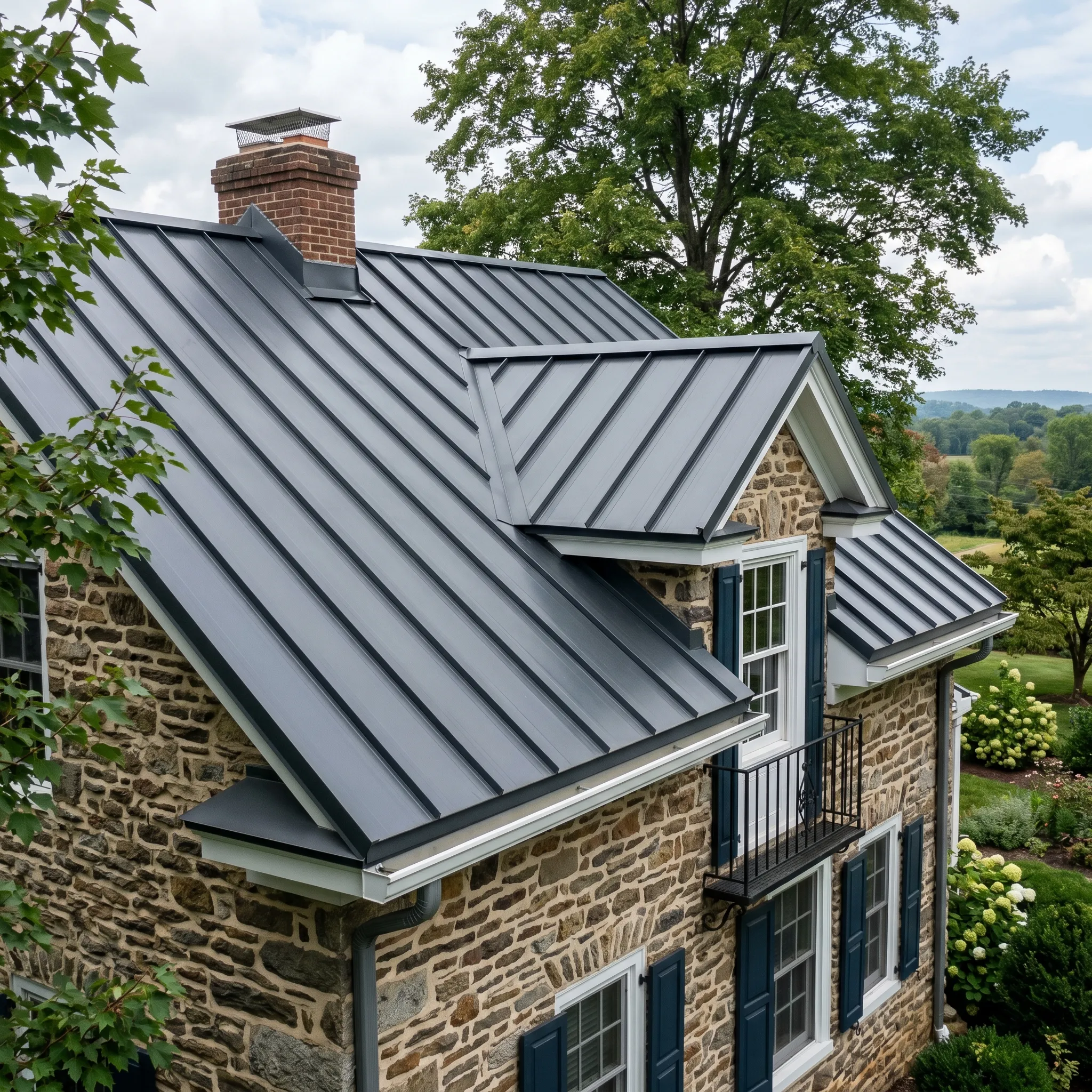
Lancaster averages about 27.5 inches of snow per season (Millersville University Weather Information Center, records 1926–2025). Smooth metal panels shed snow instead of holding it, which protects the structure — but sliding sheets can dump on walkways and gutters. Budget for snow guards over doors, porches, and walks; they're a small line item that prevents a real hazard.
A deep local craft tradition
Lancaster County is home to the world's oldest and largest Amish settlement — 45,575 people across 301 church districts in 2026, per Elizabethtown College's Young Center (reported 2026). Generations of Plain-community barn and farmhouse construction built a local bench of standing-seam craftsmanship that most U.S. counties simply don't have. The practical upside for homeowners: experienced metal crews and healthy competition on quotes.
Township-by-township differences
From Lancaster City rowhomes to Lititz boroughs to farm properties near Quarryville and New Holland, roof geometry and permit rules shift town to town. That's why per-square-foot rules of thumb only go so far — and why we quote from measurements, not averages, across all the communities we serve, including neighboring Chester County.
How to Get an Accurate Metal Roof Quote
Get two or three itemized written estimates and compare scope, not just totals. A trustworthy Lancaster County metal roofing estimate should show, line by line:
- Measured roof area in squares, not a guess from the driveway.
- Panel type, gauge, and finish — "steel roof" isn't a spec; "24-gauge standing seam, Kynar-finish" is.
- Tear-off and disposal, or the reason an overlay is safe for your decking.
- Underlayment and ice-and-water shield — non-negotiable in a freeze-thaw climate.
- Flashing, trim, ridge venting, and snow guards as separate line items.
- Permit fee for your specific municipality.
- Material price-lock window, given how tariffs have moved since 2025.
- Warranty terms — both the paint/finish warranty and workmanship warranty.
Beware quotes that are thousands below the ranges in this guide. In 2026 pricing conditions, a dramatically cheap metal roof usually means thin gauge panels, skipped underlayment, or a crew learning on your house. Roofing is one of several exterior services where the cheapest bid is often the most expensive one over ten years.
Frequently Asked Questions
The Bottom Line for Lancaster County Homeowners
Budget $5–$16 per square foot installed for common steel metal roofing in 2026, more for aluminum, zinc, or copper. Asphalt costs less on day one; metal's 60-year service life usually makes it the cheaper roof per year you own it. Local labor rates slightly below the state median, a deep regional metal-roofing craft tradition, and snow-shedding performance all work in Lancaster County homeowners' favor.
The single most useful next step: get a measured, itemized quote so you're comparing your actual roof — not a national average.
Get a Real Number for Your Roof
Double E Construction Ltd has installed metal roofing across southeastern Pennsylvania since 1997. We measure, itemize every line, and lock material pricing in writing — no surprises.
How Much Does a Metal Roof Cost in Lancaster County, PA?
Most Lancaster County homeowners can expect a new metal roof to cost between $5 and $16 per square foot installed for common steel systems in 2026 — roughly $10,000 to $32,000 for a typical 2,000-square-foot roof. Nationally, Angi puts the average metal roof at $11,754, with most projects landing between $6,045 and $18,326 (Angi, 2026).
The spread is wide because "metal roof" covers everything from budget corrugated panels to copper. This guide breaks down 2026 prices by material, the factors that move your quote up or down here in Lancaster County, and whether the long-term math beats asphalt shingles.
Key Takeaways
- Common steel metal roofs run $5–$16 per sq. ft. installed; standing seam averages about $19,000 per project nationally (Angi, 2026; HomeGuide, 2026).
- Labor is roughly 60% of the total, and Lancaster-metro roofing wages sit slightly below the Pennsylvania median — one reason local quotes often land mid-range nationally (Angi; BLS May 2025 data).
- Metal costs more upfront than asphalt but can last 60+ years per Metal Construction Association field research — often the lower cost per year of service.
- Steel and aluminum tariffs doubled to 50% in June 2025, so get written quotes with locked material pricing.
Average Metal Roof Cost in Lancaster County, PA
Plan on $10,000–$32,000 for a typical 2,000 sq. ft. roof in common steel systems, with premium metals well above that. The same Angi 2026 dataset averages $11 per square foot installed, with a full range of $4–$30 depending on material and complexity; HomeGuide's 2026 guide reports similar ranges.
Local labor keeps Lancaster County near the middle of those national ranges. Roofers in the Lancaster metro earn a median of $25.31 per hour ($52,640/year), slightly below Pennsylvania's statewide median of $26.79, per May 2025 federal wage data (BLS OEWS via O*NET). Since labor makes up about 60% of a roofing project's cost (Angi), competitive local wages matter more to your bottom line than material shipping ever will.
| Roof size | Corrugated steel | Standing seam steel |
|---|---|---|
| 1,000 sq. ft. | $5,000 – $12,000 | $9,000 – $16,000 |
| 1,500 sq. ft. | $7,500 – $18,000 | $13,500 – $24,000 |
| 2,000 sq. ft. | $10,000 – $24,000 | $18,000 – $32,000 |
| 2,500 sq. ft. | $12,500 – $30,000 | $22,500 – $40,000 |
| 3,000 sq. ft. | $15,000 – $36,000 | $27,000 – $48,000 |
Estimated installed ranges calculated from national per-square-foot data: corrugated $5–$12, standing seam $9–$16 (HomeGuide, 2026). Your roof's pitch, tear-off, and trim details move the number within — or past — these ranges.
If you'd rather skip the math and see a real number for your home, our metal roofing installation team measures the roof and itemizes the estimate line by line.
Metal Roofing Prices by Material Type
Material choice is the single biggest price lever. Corrugated steel is the entry point; copper costs five to eight times more per square foot. Here's how 2026 installed prices compare.
| Material | Installed cost / sq. ft. | Best for |
|---|---|---|
| Corrugated / exposed-fastener steel | $5 – $12 | Budget projects, barns, outbuildings |
| Stone-coated steel | $7 – $13 | Shingle or tile look with steel durability |
| Standing seam steel | $9 – $16 | Homes; hidden fasteners, longest steel life |
| Zinc | $14 – $20 | Self-healing patina, multi-generation lifespan |
| Steel (full-scope 2026 estimates) | $16 – $23 | Complex residential replacements |
| Aluminum | $17 – $25 | Rust-proof; lightweight panels |
| Copper | $29 – $41 | Historic homes, accents, bay windows |
Two notes on reading that chart honestly. First, the steel figure of $16–$23 comes from This Old House's April 2026 update, which uses Homewyse contractor estimates for full-scope replacements — it runs higher than Angi and HomeGuide because it bakes in post-tariff 2026 pricing and complete tear-off scope. Second, standing seam projects average about $19,000 nationally, with a $9,400–$32,600 range (Angi, 2026).
For most Lancaster County homes, the practical decision is corrugated versus standing seam. Corrugated saves money upfront but leaves fasteners exposed to weather. Standing seam hides every fastener under a raised seam, which is why it dominates on houses while corrugated stays popular on barns and outbuildings.
What Drives Metal Roof Cost Up or Down
Two identical-sized roofs can quote thousands of dollars apart. These are the factors doing the moving.
Roof complexity and pitch
Valleys, dormers, chimneys, and skylights all require flashing work and panel cuts. A steep pitch slows the crew down and adds safety equipment. Simple gable roofs sit at the bottom of the ranges above; cut-up rooflines climb toward the top.
Labor
At roughly 60% of project cost (Angi, 2026), labor is the biggest line item. Standing seam demands more skill than corrugated — panels are often site-formed and hand-seamed — which is part of its premium.
Tear-off vs. overlay
Removing and disposing of old shingles adds cost but lets the installer inspect and repair decking. An overlay saves money where code and decking condition allow it. You can see how finished projects turned out either way in our metal roofing project gallery.
Steel and aluminum tariffs
Material prices moved in 2025: Section 232 tariffs on imported steel and aluminum doubled from 25% to 50% effective June 4, 2025 (Federal Register, 2025), and 407 more derivative product categories were added effective August 18, 2025 (U.S. Customs and Border Protection). Tariff policy has kept shifting through 2026, so ask for written quotes with material pricing locked for a stated window.
Permits
Permit rules and fees vary by municipality in Lancaster County. Lancaster City, boroughs like Lititz and Strasburg, and each township set their own valuation-based fees under Pennsylvania's Uniform Construction Code. Your contractor should pull the permit and show the fee on the estimate — treat a contractor who asks you to skip permitting as a red flag.
Metal vs. Asphalt Shingles: Which Costs Less Over Time?
Asphalt wins on upfront price; metal usually wins on cost per year of service. A shingle roof averages $10,500 nationally, with most projects between $7,500 and $24,000 (Angi, 2026). That's about $1,300 less than the average metal roof and roughly $8,500 less than the average standing seam project, comparing Angi's 2026 averages.
Service life flips the comparison. A Metal Construction Association field study of unpainted Al-Zn coated standing seam roofs found an expected service life in excess of 60 years across a wide range of environments (MCA, 2018). Asphalt shingles are typically planned around a 15–25 year replacement cycle — a planning assumption rather than a lab figure, and the basis for the 20-year divisor in the chart below.
Put simply: a homeowner who stays 25+ years will likely buy two asphalt roofs, or one metal roof. A homeowner selling within five years may be better served by asphalt's lower upfront cost — the next section shows why.
Is a Metal Roof Worth It? Resale, Energy, and Insurance
At resale, asphalt actually recoups a higher percentage. The 2025 Cost vs Value Report puts asphalt roof replacement at 68% of cost recouped ($21,501 added value on a $31,871 job) versus 50% for metal ($25,972 on $51,865) (Zonda Cost vs Value, 2025). Metal adds more absolute dollars to the sale price — it just costs more to get there.
Energy savings — real, but modest here
The U.S. Department of Energy reports a reflective "cool" roof surface can stay more than 50°F cooler than a dark conventional roof on a sunny afternoon (DOE Energy Saver). In a mixed climate like Lancaster County's, that means real summer cooling savings but a small winter heat-gain trade-off — DOE is explicit that the biggest savings go to hot climates. Choose an ENERGY STAR-rated reflective finish for the summer benefit; don't buy the roof on energy math alone.
Insurance discounts
Many insurers offer premium discounts for impact-resistant roofing rated UL 2218 Class 4, the highest hail-impact class. State Farm, for example, says qualifying impact-resistant products may earn homeowners a premium discount, though no percentage is published. Ask your carrier before you pick a panel — the paperwork is easiest at install time.
Homeowners weighing the investment can also read reviews from area homeowners who've made the switch and lived with the results.
Lancaster County Factors That Change the Math
Snow and freeze-thaw
Lancaster averages about 27.5 inches of snow per season (Millersville University Weather Information Center, records 1926–2025). Smooth metal panels shed snow instead of holding it, which protects the structure — but sliding sheets can dump on walkways and gutters. Budget for snow guards over doors, porches, and walks; they're a small line item that prevents a real hazard.
A deep local craft tradition
Lancaster County is home to the world's oldest and largest Amish settlement — 45,575 people across 301 church districts in 2026, per Elizabethtown College's Young Center (reported 2026). Generations of Plain-community barn and farmhouse construction built a local bench of standing-seam craftsmanship that most U.S. counties simply don't have. The practical upside for homeowners: experienced metal crews and healthy competition on quotes.
Township-by-township differences
From Lancaster City rowhomes to Lititz boroughs to farm properties near Quarryville and New Holland, roof geometry and permit rules shift town to town. That's why per-square-foot rules of thumb only go so far — and why we quote from measurements, not averages, across all the communities we serve, including neighboring Chester County.
How to Get an Accurate Metal Roof Quote
Get two or three itemized written estimates and compare scope, not just totals. A trustworthy Lancaster County metal roofing estimate should show, line by line:
- Measured roof area in squares, not a guess from the driveway.
- Panel type, gauge, and finish — "steel roof" isn't a spec; "24-gauge standing seam, Kynar-finish" is.
- Tear-off and disposal, or the reason an overlay is safe for your decking.
- Underlayment and ice-and-water shield — non-negotiable in a freeze-thaw climate.
- Flashing, trim, ridge venting, and snow guards as separate line items.
- Permit fee for your specific municipality.
- Material price-lock window, given how tariffs have moved since 2025.
- Warranty terms — both the paint/finish warranty and workmanship warranty.
Beware quotes that are thousands below the ranges in this guide. In 2026 pricing conditions, a dramatically cheap metal roof usually means thin gauge panels, skipped underlayment, or a crew learning on your house. Roofing is one of several exterior services where the cheapest bid is often the most expensive one over ten years.
Frequently Asked Questions
The Bottom Line for Lancaster County Homeowners
Budget $5–$16 per square foot installed for common steel metal roofing in 2026, more for aluminum, zinc, or copper. Asphalt costs less on day one; metal's 60-year service life usually makes it the cheaper roof per year you own it. Local labor rates slightly below the state median, a deep regional metal-roofing craft tradition, and snow-shedding performance all work in Lancaster County homeowners' favor.
The single most useful next step: get a measured, itemized quote so you're comparing your actual roof — not a national average.
Get a Real Number for Your Roof
Double E Construction Ltd has installed metal roofing across southeastern Pennsylvania since 1997. We measure, itemize every line, and lock material pricing in writing — no surprises.